


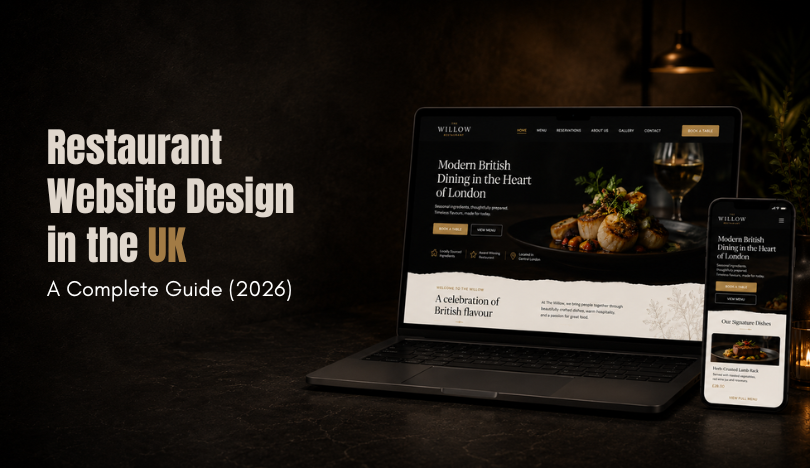
If you own a restaurant or a cafeteria in the United Kingdom, the best way for you to reach more people is building a strong website. Every day, a significant number of people go online to search for the best restaurants in their area. If they find your website on a SERP and stumble upon it, you want to create the best impression right at that point. This is why, for restaurant owners in the UK, a website should do more than just displaying information. If your website is good, it will help you attract more customers willing to book a table. Do a bad job and they will immediately search for a different restaurant to visit. This is what makes restaurant website design services in the UK such a crucial element today. The right agency can make your website attractive but that is not where the benefits end. It will also help people find your business through local searches, view your menu, check your opening hours, make a reservation, and place an online order when relevant. So you cannot simply choose an attractive template and be satisfied.
Designing the website of your restaurant requires planning. It requires a team that understands the current market and audience behaviour. Ideally, you should look for a professional website design agency in the UK for your website. But before you make that leap, having an initial idea can help you choose the right partner. That is exactly what our guide focuses on. So, without further ado, let’s dive right in!
Importance of Maintaining a Clean Website for Your Restaurant
It helps your customers decide faster
When a hungry customer comes across a restaurant website, they do not really tend to read everything on the page. They look for simple answers. For example:
- What is on the menu?
- How much does it cost?
- Where are you located?
- Are you open?
- Can I book online?
- Do you offer vegetarian or halal options?
- Can I order takeaway?
When you design your website, you should try to answer most of these questions as directly as possible. It also has to be easily accessible. Menus, for example, should ideally be presented as readable HTML pages instead of relying entirely on PDF files. This is because PDF menus are difficult to use on mobile devices and provide a poorer experience for search visibility. When information is easy to find, customers spend less time searching and more time deciding to visit, book, or order.
Mobile experience can directly affect your revenue
Restaurant websites need to assume that a significant portion of visitors will arrive from smartphones. Industry guidance cited by WebDev Wales puts mobile traffic for restaurant websites at more than 70%. People often look for restaurants on-the-go. For such customers, your website designer agency in the UK must factor in mobile responsiveness. Buttons need to be easy to tap. Menus need to be readable even if a customer does not zoom in. Phone numbers and other contact information should be presented as clickable links. Booking a table or placing an order should be absolutely convenient even on a smaller screen. Smartphone users will very likely be your largest customer base. If you serve them well, your revenue grows. If you fail there, you lose a considerable number of potential customers.
Fast loading and simple navigation builds trust
One factor that you have to consider is that restaurant customers often make decisions quicker than you think. If your website is slow or includes oversized images and unnecessary animation, they will, in all probability, jump to another website. A report by Webdev Wales confirms this pattern: slow loading speeds and poor mobile optimization among the common issues that can cost restaurants customers.
A clean website should therefore prioritize speed and clarity. Compress images without making food look unattractive, keep navigation simple, remove unnecessary elements, and make important information accessible within a few clicks. Performance is not a technical detail that customers never notice. They notice it immediately when the site does not work.
Accurate information prevents lost customers
Customers visit your website only when they are looking for some information. If the information displayed on your site is outdated, it can result in a lack of trust. Some of the areas where many restaurant owners in the UK go wrong are:
- Incorrect opening hours
- Old menus
- Inaccurate pricing
- Outdated offers
- Misplaced addresses
Even before a customer actually visits your restaurant, such inconsistent information can create a poor experience for them.
Restaurants should make it easy to keep essential information current, particularly around bank holidays, seasonal menus, special events, closures, and changes to booking policies. The website should also show the correct address, phone number, opening hours, and location details clearly. WebDev Wales recommends making location information prominent and including maps, parking information, and directions where relevant.
Restaurant Website Design in the UK: A Step-by-Step Guide
Define what your website needs to achieve
Most people, when they are designing a website for their restaurant, jump straight to deciding the colours, font, photography, animation styles, and such visual elements. These are all important for your brand language but this cannot be your starting point. Before you make any such decisions, you need to ask yourself a simple question: What exactly do you want your website to do? For example, if your website should primarily focus on getting table bookings, then it needs to be different from the website of a takeaway restaurant. For a pub, you might need to include an events calendar. For a cafe, you should ideally highlight brunch, coffee varieties, atmosphere, WiFi connectivity, and remote-working facilities.
You have to start by understanding the primary customer action you want to encourage. When you have a clear goal, then you can design your website around that goal.
Build a mobile-first menu experience
For a restaurant website, your menu is the most important piece of the puzzle. Your customers will want to know what exactly you serve and how much it probably costs. So, you cannot simply upload a PDF and consider your job finished. The best idea is to ask your website design partner in the UK to build a proper web-based menu with categories, dish names, descriptions, prices, and relevant dietary information. According to WebDev Wales, HTML menus work better than PDF menus because they work better on mobile screens. On top of this, the system must be easier for your employees to update the relevant information whenever something changes.
Use authentic food photography
When you design your website, you simply have to include photos of the dishes you serve. If these photos do not make your customers feel hungry, then they are simply not working. Customers cannot taste or smell your food from your website. They will pass their judgement completely based on the visual cues. So, avoid using stock images on your website. Instead, showcase photographs of your actual dishes, restaurant interiors, bar areas, outdoor seating, and other spaces customers will experience. Good photography does two things at once. First, it makes your website attractive. Second, it helps customers understand exactly what sort of experience they are buying. Both contribute to a good impression for your brand.
Design and build for local SEO
When you operate a restaurant, your target customer base does not lie a hundred kilometres away. Most restaurants depend heavily on local customers. This means that your restaurant website design in the UK has to factor in local SEO. On the website, you have to clearly communicate:
- Restaurant name
- Address
- Phone number
- Opening hours
- Cuisine type
- Areas served
You also have to ensure that your Google Business Profile is updated and the information there matches your website. Furthermore, if you integrate location-specific content and elements into your website, it can strengthen your relevance for searches like “Italian restaurant near me” or “best Sunday lunch in Manchester”.
Estimated Cost of Restaurant Website Design Services in the UK
| Restaurant Website Type | Estimated Cost | Common Features |
| Basic | £500 to £1,500 | Menu, contact details, location, opening hours |
| Professional | £1,500 to £3,000 | Custom design, booking, photography, local SEO, analytics |
| Online ordering and takeaway | £3,000 to £8,000+ | Online ordering, payments, delivery, booking, integrations |
| Advanced/multi-location website | £8,000+ | Multiple locations, advanced ordering, loyalty, custom integrations |
Conclusion
A restaurant website should make choosing your restaurant easier. It should show the food clearly, answer practical questions quickly, make booking or ordering simple, and give customers enough confidence to take the next step. This means that when you hire website designers in the UK, they have to think from a customer’s perspective. An agency that understands how customers think can usually create a better design compared to one that only cares about the technical expertise.
At PTI WebTech, we offer professional website design and development services in the UK. In our services, we also cover SEO, GEO, performance tracking, integrations, and on-going support for every future need. We can help you create a website that brings people through your door.