


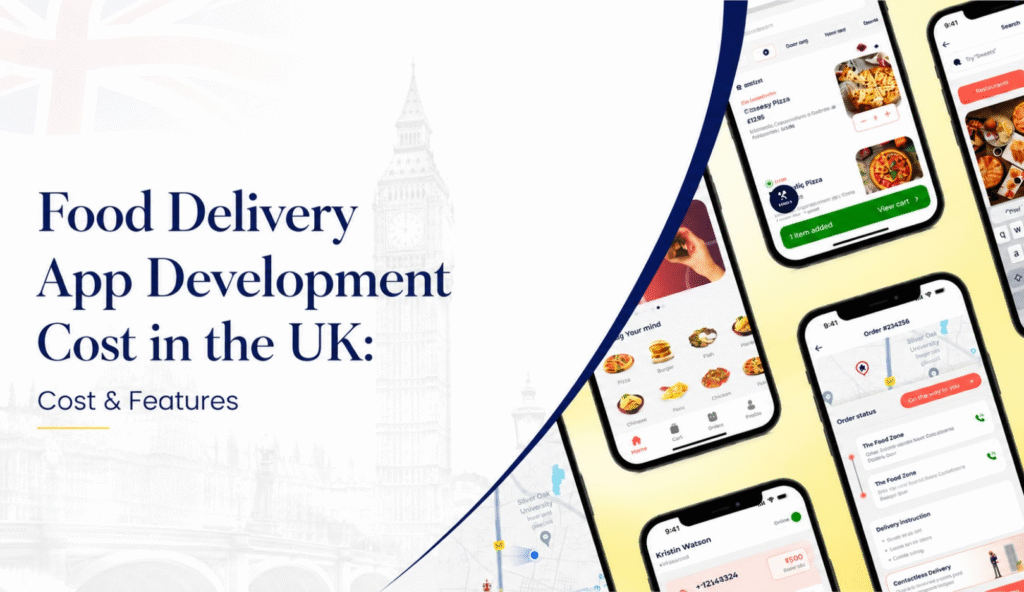
In the last few years, there has been a drastic change noticed in the food industry of the UK. Now, the customers are more inclined towards online ordering systems, quick delivery, and live tracking options. Earlier restaurants used to focus on walk-in customers, but now they are more invested in online orders. It is very important to remain relevant in a competitive market.
This has resulted in increasing demand for online food ordering apps in the UK. It has now become a favourite of all the businesses, from individual cloud kitchen owners to large food chain businesses.
Why Businesses in the UK Are Investing in Food Delivery Apps
Increasing customer demand for online food ordering
The online ordering facility from the mobile applications has completely changed the behaviour of the customers in the UK. Now they prefer:
- Ordering quickly with a smooth experience
- Having multiple payment options
- Tracking their delivery in real-time
- Customised offers according to their requirements
- Delivery without contact
It helps the business owners to retain customers and gain new ones as well. Restaurants can also increase the volume of their order by giving exciting offers and discounts. This is one of the primary reasons for restaurants now to invest in custom food delivery app development in the UK.
Provides better operational management
A well-developed food delivery app enables managing operations more efficiently. It provides them with an option to handle orders automatically instead of doing it manually. It also helps in:
- Confirming the orders
- Notifying kitchen
- Assigning delivery partners
- Contacting customers
- Processing the payment
- Rising customer retention
Mobile applications help in maintaining long-term customer relationships. Customers get encouraged to place repeat orders when they get features like loyalty rewards, customisation, and push notifications.
Major Types of Food Delivery Apps
Restaurant-focused Food Delivery Apps
These apps are built for individual restaurants or restaurant chains. Customers can order online directly from the business without the interference of third-party marketplaces. The online food ordering apps give restaurants control over:
- Building brand
- Fixing prices
- Maintaining customer data
- Promoting business
- Managing delivery
Platforms aggregating the restaurants
This app connects multiple restaurants with customers through a single platform. Popular food delivery companies in the UK operate on the basis of this model. These applications need more advanced development because they involve:
- Dashboards of the restaurant
- Applications for customer
- Applications for driver
- Admin panels
- System of commission
Cloud kitchen delivery apps
Cloud kitchens operate fully online without physical dining spaces. These businesses depend mainly on mobile ordering systems. Cloud kitchen applications usually focus on:
- Fast ordering flow
- Delivery optimisation
- Location-based targeting
- Inventory management
Cloud kitchens continue expanding across the UK. Many businesses are investing in customised delivery applications designed specifically for this business model.
Important Features That Influence Food Delivery App Development Cost
User registration and profiles
Every food delivery application requires a user account system. Customers should be able to:
- Create accounts
- Save addresses
- Manage payment methods
- View order history
- Update personal information
Menu designing and restaurant listings
Customers place orders on the basis of menus with detailed descriptions, pricing, and images. An advanced online ordering platform should include:
- Filters for separating category
- Preferences according to diet
- Personalised addition of items
- Offers for combo of food items
- Data of available stock
Online order tracking of delivery in real time
Tracking in real time is one of the most advanced features of an online food ordering application. Customers prefer transparency in:
- Confirming order
- Preparing food
- Assignment of driver
- Estimated timing of food delivery
- Tracking live driver location
Integration with Payment Gateways
There are multiple payment options available for payment on the food ordering applications in the UK, including:
- Bank debit cards
- Banking credit cards
- Online and digital wallets
- Online banking
- Payments without contact
Push Notifications for Placing Orders
It encourages customers to place repeat orders and helps restaurants to improve customer retention rates. Restaurants generally use notifications for:
- Updating orders
- Offers for promotions
- Campaigns related to discounts
- Delivery notifications
- Loyalty rewards
Ratings and Reviews by Customers
Review systems by the customers help other customers to make better decisions while placing orders regarding choosing restaurants and dishes. Users can rate:
- Food quality
- Delivery speed
- Customer service
- Restaurant experience
Delivery Management System
A delivery management system allows and helps in assigning drivers and monitoring deliveries efficiently. It includes:
- Route optimisation
- Driver earnings
- Delivery status tracking
- Delivery zone management
- Automated despatch systems
Admin Dashboard
The admin panel controls the entire platform operation. Administrators generally focus on managing:
- Service providing restaurants
- Customers ordering food online
- Drivers making deliveries
- Payments by the customers
- Commissions of the platform
- Reports of the sale
- Analytics for improvement
Food Delivery App Development Cost in the UK
| Platform Type | Cost |
| Basic food delivery app | A basic food delivery application with important features may cost somewhere between £15,000 and £30,000. |
| Mid-level food delivery app | A moderate-level application may cost between £30,000 and £70,000. |
| Advanced aggregator platform | Large-scale food delivery marketplaces can cost between £70,000 and £200,000 or more. |
Factors influencing Food Delivery App Development Cost
Platform selection
Businesses can build the following:
- Android apps
- iOS apps
- Cross-platform applications
- Web applications
Developing separate native applications for Android and iOS increases overall cost but may improve performance.
Backend Infrastructure
Food delivery apps require large amounts of real-time data. The backend system involves dealing with:
- Live orders on the app
- Payment processing by the customer
- GPS tracking of the drivers
- Notifications of every stage to the customer
- Database management for the entire process
Third-party inclusions
Food delivery applications usually deal with external systems, including:
- Payment gateways for customer convenience
- Mapping services for tracking deliveries
- CRM software
- Accounting systems for better management
- Marketing platforms for advertisement
Additional integrations result in increasing both development time and maintenance requirements of the application.
Choosing the Right Food Delivery App Development Company in the UK
Selecting the right development partner is one of the most important decisions in the entire process. Businesses should select agencies based on the following:
- Earlier food delivery app development projects
- Technical expertise
- UI/UX capabilities
- Scalability planning
- Communication process
- Post-launch support
Questions to Ask Before Starting Development of the food ordering Application
What technology do you recommend specifically?
The development company should explain why particular technologies are suitable for your application requirements and future scalability of the business.
What security measures will be implemented in the app?
Businesses should understand how customer data and payment information will be preserved throughout the platform.
Conclusion
The UK food delivery industry grows rapidly as customer expectations incline towards faster and more convenient digital experiences regarding online food ordering. The food delivery applications position businesses more effectively in this competitive market. The development cost mainly involves the platform’s complexity, feature set, integrations, and long-term scalability requirements. While smaller restaurant applications may require a moderate investment. The advanced aggregator platforms involve much advanced development and operational planning which would be beneficial for the business in future.