


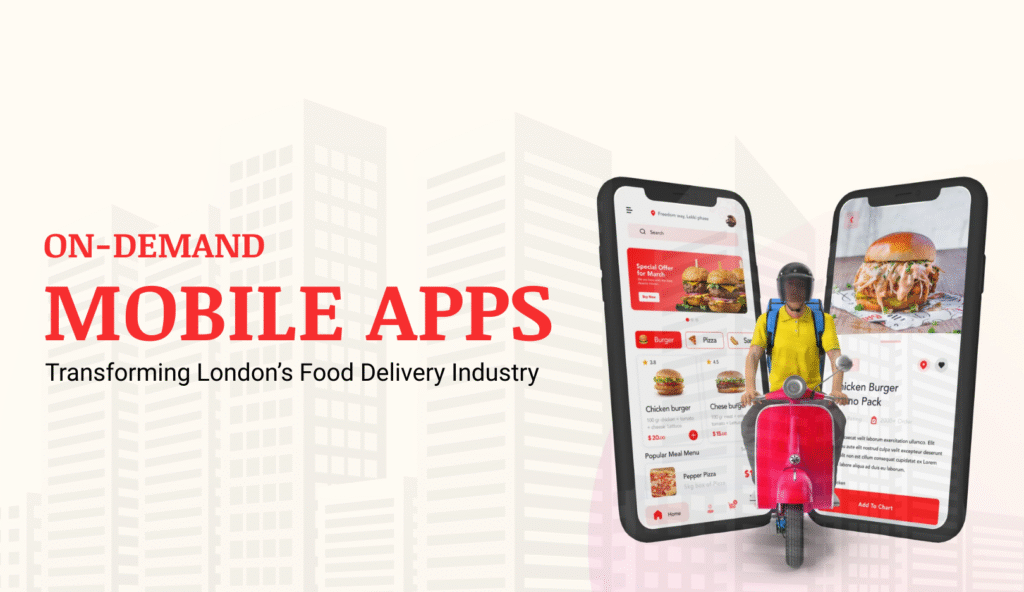
Time is the most valuable thing in our lives, which we cannot buy with money. It is very important to save and utilize time whenever and wherever we get a chance to do so. Technology has made it very convenient to save our time just by spending some money, which is of course worth it for the cost of time. Food delivery is one such way that makes us save our time and utilize it elsewhere more necessarily. It helps us to order food while sitting and taking rest at your place without worrying about anything.
We can also use this for ordering for someone else to make them feel special. It does not require a lot of effort and money to do so. There are many mobile applications that are in demand for food delivery across the globe. PTI WebTech is a company that is offering services for on-demand mobile app development for the food delivery industry. You may get in touch with them for a reliable and seamless experience.
Market dynamics of the Food Delivery Industry in London
The food delivery industry of London is reshaped by the on-demand mobile apps, which have a worth of 14.3 billion euros in the UK in 2025. The main reason behind this shift is convenience with the digital platforms. London is leading the UK delivery industry by holding 21.1% of the total market. This is because of the consumer density and digital adaptation by the users. This is a very competitive market for London-based mobile app solutions. One has to be very convenient and competitive to stand out in this market. There is a fierce competition between the established aggregators and the rising “direct-to-consumer” brand applications.
Innovations in technology and operations
The physical dining scene in London has been converted into the home dining concept. There has been a revolution in the field of the food industry, which has brought many technical and operational changes in the lives of the consumers as well as restaurant businesses.
AI and data analytics
The food delivery industry uses AI-based mobile apps for customized recommendations, optimization of delivery routes, and variation in pricing, focusing on the real-time demands. This leads to enhanced user experience and helps the restaurants to reach out to the customers very easily through analyzing their behavioral searching and ordering.
Dark stores and ghost kitchens
This idea of rapid delivery has made the food delivery industry very fast and pressurized at the same time. The brands are choosing this method of service for making the customer experience very unique, taking a very small amount of time without compromising the quality of the products. The concept of “cloud kitchens” facilitates an AI-based logistics center where the algorithm predicts demand based on the local weather, sports events, and transit delays.
White-Label Integration
The modern technology allows the restaurants to integrate with multiple third-party food delivery apps in a single system, streamlining operations and reducing errors.
Effects of transformation in the food delivery industry
Economic growth
There is a huge increase of 87% in the food delivery market of the UK as of 2025 from 2019. It plays a vital role in the economic growth of the country.
Categorization of services
The categories of the services in the delivery market have been diversified beyond food delivery to quick commerce, delivering groceries, pharmaceuticals, and gifts.
Beneficial for small businesses
These mobile applications help the small business restaurants to grow their revenue to an average turnover of 100,000 euros by expanding their reach apart from the local traffic problems. These mobile applications act as a lifeline for these small businesses.
Challenges for the Food Delivery Mobile App Development
A London-based food services platform development company may face many problems related to various aspects.
Regulatory compliance
The food services industry faces strict labor regulations such as the Employment Rights Bill, which focuses on addressing the gig economy’s worker rights and payment-related issues.
High operational costs
The increase in commission rates and labor costs is leading to a reduction in margins for both the platform and partner restaurants.
Demand for sustainability
There is an increase in demand for eco-friendly packaging and carbon-neutral delivery as people of London are becoming more aware about sustainable development. They are very conscious about environment protection and pollution-free surroundings. Approximately 85% of the food deliveries in London are completed by using electric bicycles or scooters. The majority of the mobile app development agencies in London use a feature that displays a “carbon footprint” score, which helps the customers to select their meals wisely with sustainability.
Hiring mobile app developers
It has become very challenging to hire a mobile app developer in London. The primary hiring requirements include AI integration and security-first architecture. The largest share of developer talent in the UK is in London, and it is very costly to hire mobile app developers in London.
Read More: Cost of Mobile App Development in London: 2026 Pricing Guide
What can be the future of these food delivery mobile applications?
This technology can be converted into a “lifestyle operating system,” which includes the food industry, healthcare industry, and many more diverse sectors.
Serving groceries and hot food
With the help of these food delivery apps, it has become very easy to order anything from hot food to groceries for everyday needs. It is very helpful for senior citizens living alone, as they cannot move from one place to another just to get these everyday essentials.
Integration with Healthcare
There are multiple benefits of these mobile applications, such as syncing with wearable health data to suggest meals based on the user’s nutritional needs or fitness goals. This helps a person to trace their health requirements and fulfill it on time.
Virtual Reality Dining
High-facility restaurants are experimenting with delivery experiences that include virtual reality elements. It allows the user to experience the atmosphere of the restaurant while sitting in their living room.
Conclusion
These on-demand mobile applications have completely transformed the food delivery industry of London. The “disruption” phase of the industry has been moved into a “maturity” phase. There are many challenges regarding the regulatory compliances, low business margins, and worker rights. Despite all the challenges, the London food scene is unparalleled. If you also want to be one of the established and recognized on-demand food delivery mobile app development companies, contact the most trusted mobile app development company, PTI WebTech. It helps you to grow your business and gets you on the way to your dreams.